


2026/6/8 13:54:04
Major Milestone: Affinity’s Legubicin for Injection Granted FDA Orphan Drug Designation, Ushering in a New Chapter for Soft Tissue Sarcoma Treatment
At the 2026 Annual Meeting of the American Association for Cancer Research (AACR), Affinity officially unveiled preclinical data for its globally first-in-class chemically conjugated dual-masked CLDN6-CD3 TMEA-TCE (IMD1743). IMD1743 is Affinity’s proprietary tumor microenvironment (TME)-activated CLDN6-CD3 T cell engager (TMEA-TCE). Leveraging a “single-point chemical conjugation for dual masking of bispecific antibodies” technology, it addresses the life-threatening cytokine release syndrome (CRS) and normal tissue toxicity associated with conventional CD3 T cell engagers, achieving the dual breakthrough of potent anti-tumor activity and controllable safety.

In preclinical studies, IMD1743 demonstrated a differentiated advantage of “potent anti-tumor activity with no observed CRS signals”, offering a novel, safe and effective treatment option for patients with CLDN6-positive solid tumors (e.g., ovarian cancer, endometrial cancer) and holding great potential for clinical development.
Key Technological Innovation Highlights
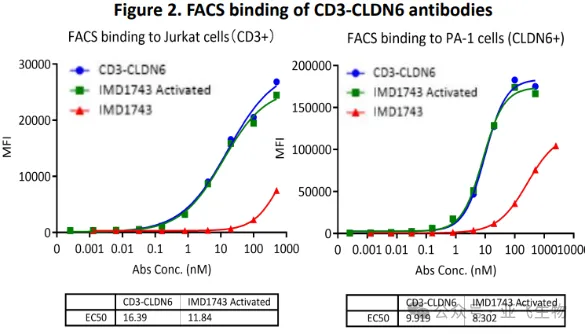
l CLDN6 is a tumor-specific target with high expression in tumors and no expression in normal tissues.
l The CLDN6 antibody in the bispecific exhibits high selectivity for CLDN6, with no cross-reactivity to CLDN9/CLDN4. Its binding activity is significantly superior to marketed/development-stage comparator molecules even in CLDN6 low-expression tumor cells.
2. Single-Conjugate Dual Blocking Masking and Efficient Activation Design
l After the CLDN6-CD3 bispecific antibody undergoes single-point chemical conjugation with the TMEA linker and masking moieties, its binding activity to both CD3+ cells and CLDN6+ cells is inhibited by dual masking, resulting in an overall binding affinity reduction of >10,000-fold. This eliminates TCE-related toxicity in blood and normal tissues, thereby improving the drug’s safety profile.
l In the tumor microenvironment, the conjugated masking moiety has no affinity for the antibody’s binding regions. The selected high-efficiency cleavable TMEA linker only needs to be specifically cleaved once by the tumor extracellular enzyme Legumain. The masking moiety then rapidly dissociates, efficiently restoring binding affinity and enabling potent bispecific activity specifically within the tumor.
Non-Human Primate (NHP) Safety Verification
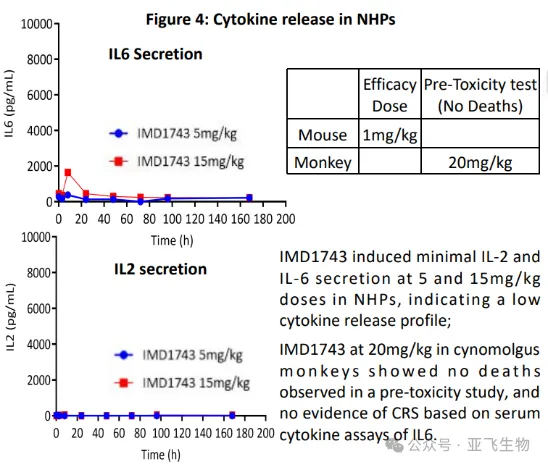
l Following a single administration, IMD1743 demonstrated high exposure and a long half-life in cynomolgus monkeys.
l At doses of 5 mg/kg and 15 mg/kg, the release levels of IL-2 and IL-6 cytokines were extremely low. In the pre-toxicity study in monkeys, the high dose of 20 mg/kg resulted in no deaths and no CRS-related toxicity signals, demonstrating excellent systemic safety.
In Vivo Antitumor Efficacy
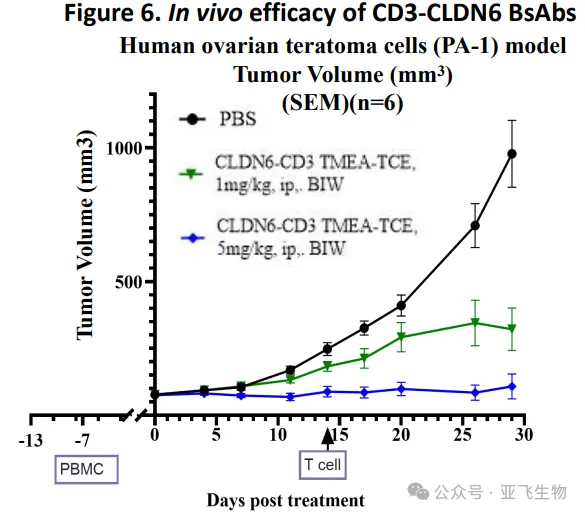
l In the PA-1 human ovarian teratoma xenograft model, IMD1743 exhibited dose-dependent antitumor activity. Antitumor efficacy was observed even at the 1 mg/kg dose level, with no significant toxicities observed.
About IMD1743
(CLDN6-CD3 TMEA-TCE) is a novel tumor microenvironment (TME)-activated T cell engager (TCE). It comprises CLDN6- and CD3-binding domains and is engineered via site-specific chemical conjugation with a Legumain-cleavable linker and masking moieties. Within the tumor microenvironment (TME), the tumor-specific extracellular Legumain protease cleaves the TMEA linker, releasing the masking moieties. This enables the bispecific antibody to function exclusively in the tumor microenvironment, triggering targeted T cell activation and killing CLDN6-positive tumor cells.
About the American Association for Cancer Research (AACR)
The AACR Annual Meeting is a premier global platform for advancing cancer research. Scientists, clinicians, healthcare providers, cancer survivors, patients, and advocates convene annually to share cutting edge breakthroughs. The congress spans population science, prevention, cancer biology, translational and clinical research, survivor care, and patient advocacy, showcasing the full spectrum of innovative cancer science and medicine.
About Affinity (Shanghai) Biopharmaceutical Co., Ltd. ("Affinity")
Leveraging its globally first-in-class and proprietary Tumor Microenvironment-Activated (TMEA) technology platform, Affinity develops and advances highly selective, low-toxicity innovative anti-cancer drugs. The company is dedicated to solving the toxicity challenges of traditional chemotherapy and targeted therapies, focusing on unmet medical needs in oncology, with the potential to transform traditional treatment approaches and reshape the cancer care paradigm.
Looking ahead, Affinity aims to become a fully integrated biopharmaceutical company with robust manufacturing and commercialization capabilities.